
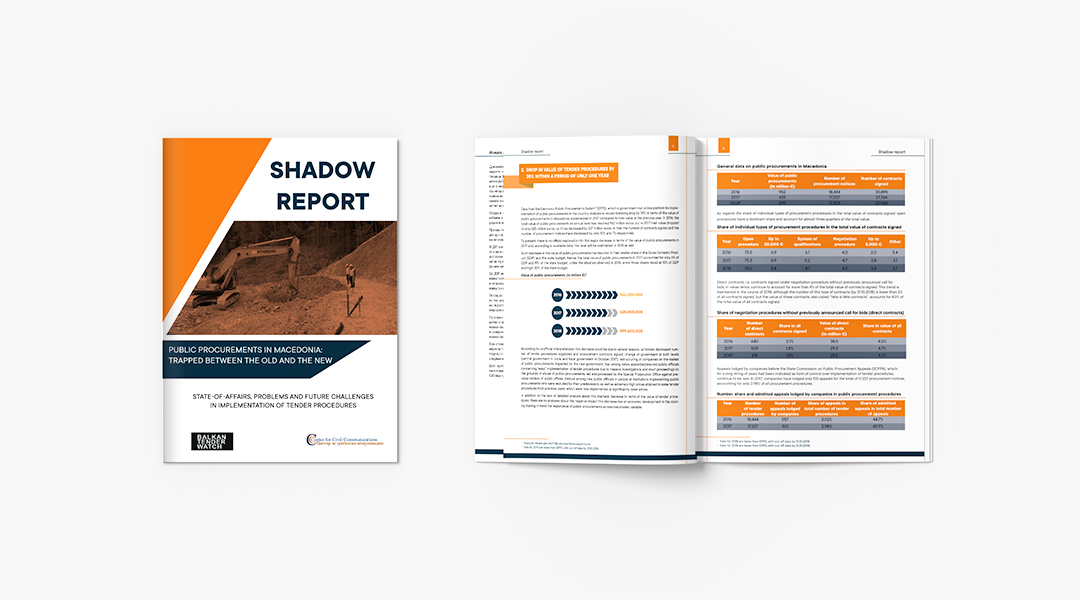
In 2018, state-of-affairs related to public procurements in Macedonia are still trapped between the valid “old” and heavily criticized Law on Public Procurements and the already drafted “new” law that should “correct” matters, but is still pending enactment by the Parliament of the Republic of Macedonia.
The most heavily criticized specificity of the system of public procurements in Macedonia, i.e. the infamous Council of Public Procurements responsible to provide previous approval to all public procurements that could not demonstrate minimum level of competition on the relevant market, was terminated in November 2017, in response to numerous remarks and concerns raised by all parties. However, that solved only portion of problems plaguing public procurements, given that other disputable provisions from the law are still in effect, notably those that were in place prior to establishment of this council that only further complicated matters.
The current version of the Law on Public Procurements is not aligned with EU Directives from 2014 in many segments and, in spite of the fact that the EU has noted these concerns in several consecutive country reports and has requested urgent changes to be made, that did not happen. The previous government turned the deaf ear to criticism of this type, while the new government (in office since June 2017) attempted to mitigate criticism by engaging in development of completely new legislation. Be that as it may, the new law is still not adopted, allowing public procurements to continue to be implemented pursuant to regulations that had been strongly criticised not only by Brussels, but also by domestic factors in this process, such as: contracting authorities, companies, chambers of commerce, civil society organizations, regulatory and oversight institutions, etc.
Except at systemic level, problems related to implementation of public procurements were also noted at the level of institutions. According to different research studies1 on practices related to implementation of tender procedures, institutions that spend the highest amount of public funds demonstrate the lowest level of transparency, accountability and integrity in public procurements. In particular, procurement planning and contract performance continue to be the weakest links in the cycle of public procurements.
Although the year 2018 nears its end, the last annual report published on performance of the system of public procurements in Macedonia is still the 2016 annual report. Non-publication of annual report for the previous year by the end of November in the current year amounts to precedence in the recent history in Macedonia. In that, there was no public and official explanation about reasons behind this record-breaking delay.
Otherwise, annual reports provide detailed overview on implementation of public procurements and, in general, performance of the system of public procurements in the country, including analysis of the market of public procurements and proposals aimed to advance the system as a whole. According to practices in place, annual reports are adopted by the Government, after which the Bureau of Public Procurements (BPP) publishes them on its official website.
You can read the shadow report in Macedonian and English language
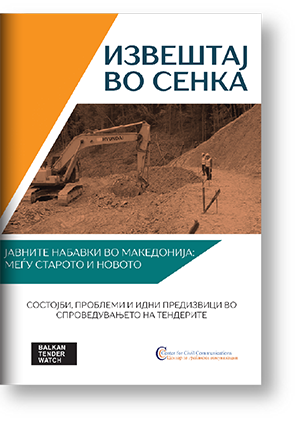
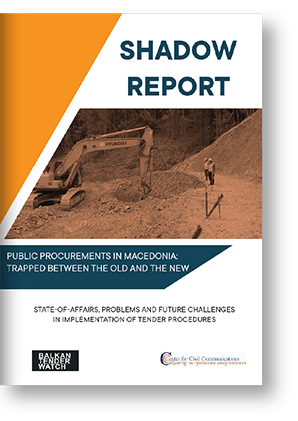
This publication is developed with financial support from the European Union with the Balkan Tender Watch project.
For more information, please contact the Center for Civil Communications at (02) 3213-513 or at center@ccc.org.mk.