
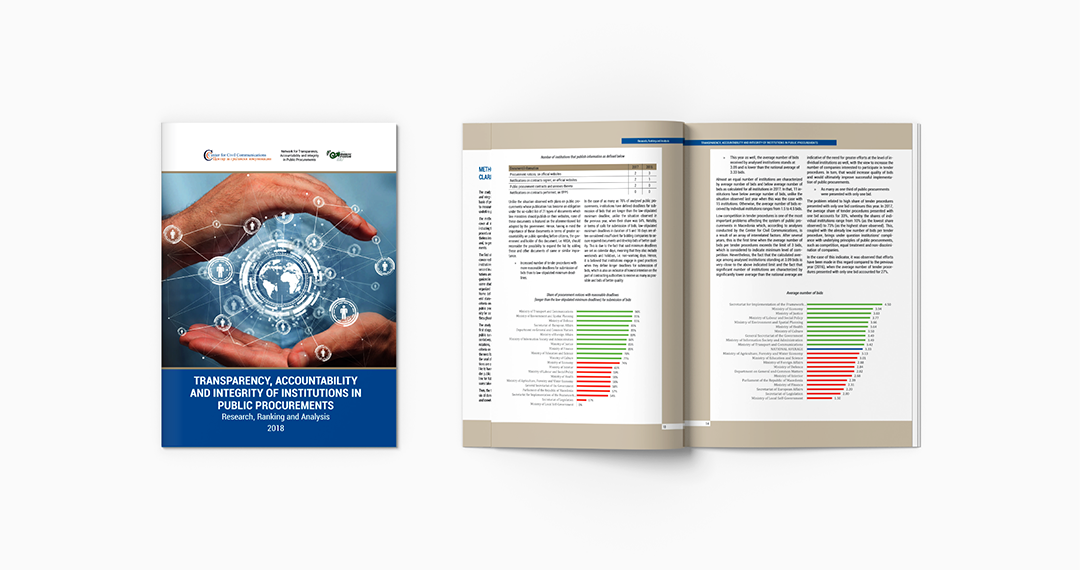
Key findings:
- The average level of compliance with criteria on transparency, accountability and integrity throughout the entire cycle of public procurements, as demonstrated by line ministries, government secretariats and Parliament of the Republic of Macedonia stands at 53.6% (from 100%) and implies small improvement compared to the previous year (51.7%).
- Institutions that have spent the lowest amount of funds on public procurements are also the highest ranked ones.
- Not a single institution has developed methodology, guidelines or similar document that governs the method for calculation of procurements’ estimated value.
- Implementation rate of plans on public procurements has deteriorated. The average implementation rate of these plans in 2017 stands at 62%, compared to the previous year when it was 65%. At the level of individual institutions, the lowest implementation rate is 21%, while the highest stands at 87%.
- Only two institutions publish procurement notices, notifications on contracts signed, as well as the contracts and annexes thereto, on their official websites, while no institution published notifications on public procurement contracts performed.
- Increased number of tender procedures with more reasonable deadlines for submission of bids than the law-stipulated minimum deadlines.
- This year as well, the average number of bids received by analysed institutions stands at 3.09 and is lower than the national average of 3.33 bids.
- As many as one third of tender procedures were presented with only one bid.
- The highest average share of tender procedures marked by participation of one company in the total number of public procurements organized by individual institutions accounts for 25% and is the same as the share observed in the previous year. Only two institutions have shares higher than 40%, which is considered as threshold for concentration.
- Almost one third of tender documents developed by analysed institutions feature discriminatory elements that could limit competition.
You can read the research in Macedonian and English language
For more information, please contact the Center for Civil Communications at (02) 3213-513 or at center@ccc.org.mk.
This publication was produced with the financial support of the European Union.