

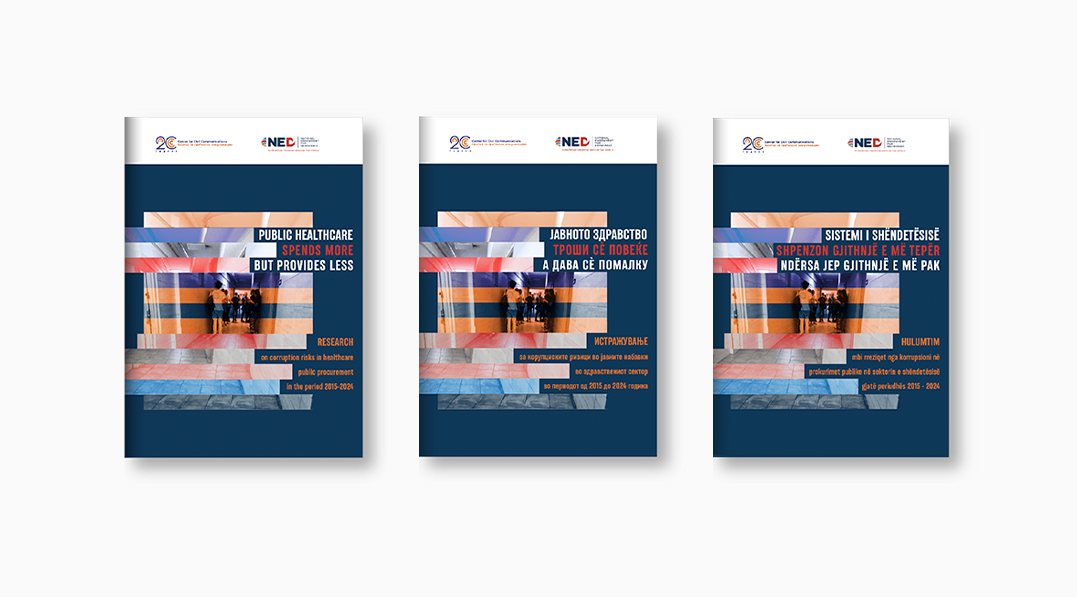
Today, November 11th, 2025, the Center for Civil Communication published the research on healthcare public procurement for the period 2015-2024. The research titled Public Healthcare Spends More, But Provides Less showed that:
» In the last 10 years, public procurement costs have increased by two and half times, from 126 million EUR in 2015 to more than 315 million EUR in 2024. Inflation-related factors are not sufficient to justify the enormous rise in value of public procurement.
» There is a gap between increased value of public procurement and decline of services provided by public healthcare institutions, which gives rise to serious suspicions that public procurements are used as means to withdraw budget funds, instead of being an instrument to promote healthcare.
» The highest value growth in public procurement is noted among clinics and hospitals. However, instead of more services and better care, the citizens are faced with a different reality – the value of tenders is on the rise, but operation of clinics and hospital declines. In the period 2015–2024, the number of medical consultations performed by all 55 clinics and hospitals was reduced by 14%, while the number of inpatient days was decreased by 24%.
» Growing costs of healthcare public procurement cannot be justified with the number of specialist consultations. The last three years have seen an evident decline of specialist consultations by around 700,000, i.e. by 19%. In the field of gynaecology and obstetrics, as well as in the field of transfusion medicine, this decline exceeds 60%.
» Having in mind that the National System of Material and Financial Management at Public Healthcare Institutions is still not established, although mandated by law since 2015, major differences between value of public procurement and services provided indicate to high risk of abuse, i.e. non-utilization of medicines and reagents procured to treat patients at public healthcare institutions.
» Significant growth under the value of healthcare public procurement is accompanied by progressively lower number of tender participants. Almost half of the cumulative value of all contracts is awarded under tender procedures that were presented with only one bid.
» Tender procedures for procurement of reagents and tests, to great extent, are implemented as mere formality because they are organized for pre-defined apparatus, which means that the tender winner is known before the procurement procedures is initiated. Laboratory apparatus are previously obtained as donations, loaned for use or bought from companies sell the corresponding reagents. On annual level, the value of public procurement for reagents and tests reaches up to 29 million EUR and has increased by 81% in the analysed period.
» Valued up to 39 million EUR, biannual tenders for procurement of insulin, glucagon, insulin needles and blood sugar test stripes, insulin pumps and glucose monitoring sensors are organized under procedures marked by lack of competition and are followed by signing of annex contracts. In the 10-year period analysed, the number of patients receiving insulin therapy has increased by 21%, but the value of corresponding public procurement was increased by 77%. Year after year, the programs for provision of insulin are becoming shorter, while program implementation reports are not published regularly and ;ack public account for the money spent.
» In financial terms, tenders for immunization of the population are becoming bigger, but public procurements organized in some years are marked by weaknesses, ranging from flawed procurement planning to failure to timely award the contracts.
» In the last decade, the costs for rare disease medicines have increased from 1.5 million EUR to 9 million EUR. Such great increase of value takes place at times when the State Audit Office had noted that the Ministry of Health does not dispose with comprehensive data whether the therapy in question actually improves the patients’ health status. The reason thereof is seen in non-performance of evaluations for large share of diseases covered by these medicines, as anticipated under the Program for Treatment of Rare Diseases.
» Lack of qualified staff for implementation of public procurement is another corruption factor. The research found that as many as 23 from the total of 110 healthcare institutions do not have a single staff member with passed public procurement exam, which is contrary to the Law on Public Procurement.
» In the absence of efficient supervision and monitoring mechanisms, large sums of public funds are under risk of being spent without yielding proportional improvements.
The research can be downloaded in Macedonian, Albanian and English language
The research is conducted as part of the project “Combating Corruption in Healthcare Public Procurement”, implemented by the Center for Civil Communications with financial support from the National Endowment for Democracy (NED).
For more information, please contact the Center for Civil Communications at (02) 3213-513 or at center@ccc.org.mk.