

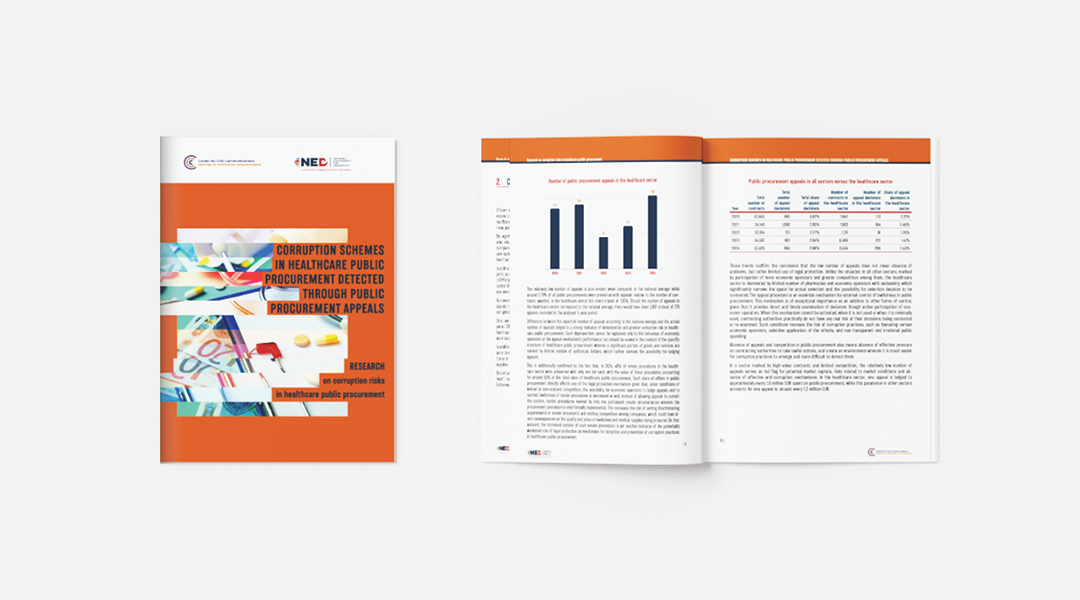
Today, April 9th, 2026, the Center for Civil Communications published the research on corruptive schemes in healthcare public procurement detected through public procurement appeals.
In particular, the research shows that:
- In 71% of all cases, appeals lodged by the companies contest the decision on selection of the most advantageous bid, which shows that the main source of dispute arises from the bid-evaluation process as the procedure stage marked by the highest risk of favouring particular bidders.
- The analysis of appeals indicates that public healthcare institutions often engage in imprecise evaluation of bids received and apply inequitable criteria for that purpose, resulting in selection of bids that do not meet the requirements defined in tender documents.
- One of the most frequent problems concerns unclarities relating to documents required for market placement and import of medicines, thus creating administrative obstacles in tender procedures and increasing the risk of subjective actions.
- Also, tender procedures include disproportionate and selectively defined technical criteria or technical criteria are frequently changed during the procedure, which creates conditions for favouring certain companies and generating corruption.
- The State Commission on Public Procurement Appeals has approved 42% of appeals lodged by the companies, which means that it has established irregularities in almost every second healthcare public procurement.
- Certain pubic healthcare institutions do not act upon decisions taken by the State Commission on Appeals, which undermines the principles of lawfulness and legal security and creates doubts about hidden favouritism of certain companies.
- The share of appealed tender procedures in the healthcare sector stands at 1.95% and is lower from the already low share of appealed public procurements at national level, which is 3%. This indicates to the fact that legal protection is not used as efficient instrument to combat corruption in public procurement.
- The relatively low number of appeals create a situation in which public healthcare institutions are not under sufficient external pressure to comply with the legislative norms., which increases the risk of biased contract-awarding and abuse of public funds.
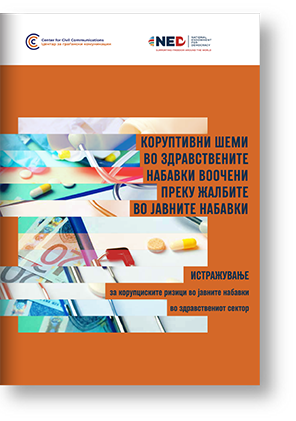
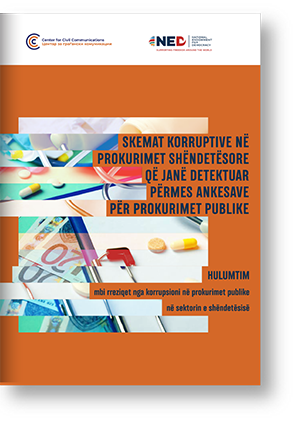
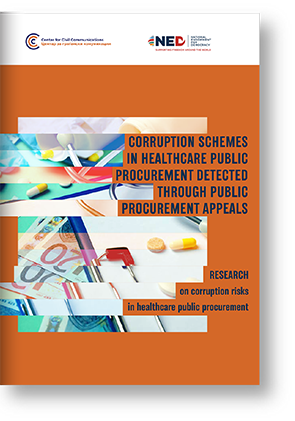
The research can be downloaded in Macedonian, Albanian and English language
The research is conducted as part of the project “Combating Corruption in Healthcare Public Procurement”, implemented by the Center for Civil Communications with financial support from the National Endowment for Democracy (NED).
For more information, please contact the Center for Civil Communications at (02) 3213-513 or at center@ccc.org.mk.