

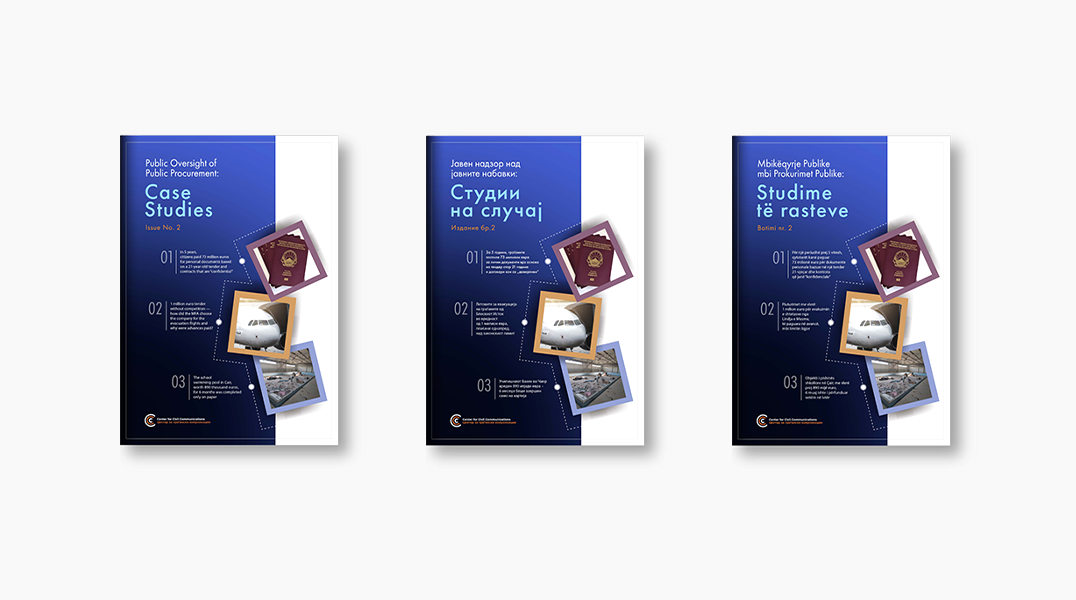
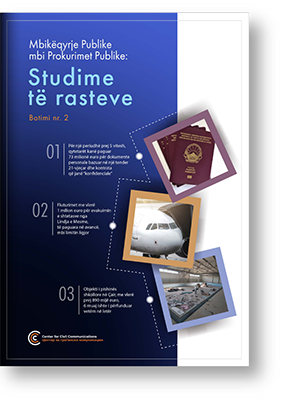
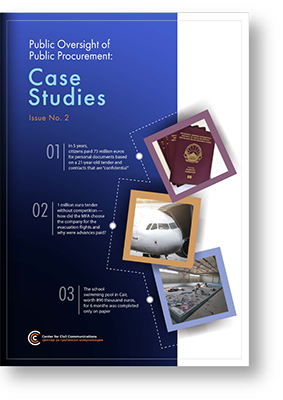
Today, June 11, 2026, the Center for Civil Communications published the research Public Oversight of Public Procurement (Issue No. 2). Specific cases were analyzed of potentially illegally conducted tender procedures in which the care for public money was not primary. These cases are selected through an analysis of the findings of the red flags applied by the Public Procurement Bureau, through research based on publicly available information, as well as through consultations with citizens. We highlight some of the key findings from 3 analyzed tenders:
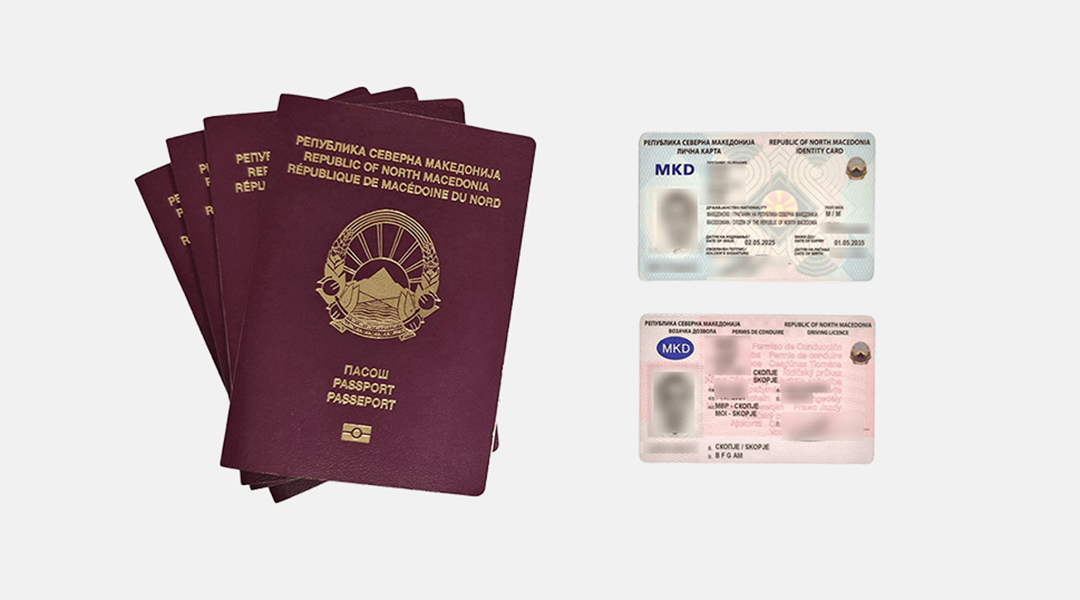
- Procurement of passports, ID cards and driver’s licenses:
In 5 years, citizens paid 73 million euros for personal documents based on a 21-year-old tender and contracts that are “confidential”.
- The production of passports, ID cards and driver’s licenses in the last five years cost MIA 29 million euros, and to obtain these documents, citizens paid 73 million, or 44 million euros more.
- Most of the 73 million euros paid by citizens are for obtaining a passport, as much as 60 million euros over 5 years.
- The documents are prepared by a company that won a tender 21 years ago. MIA does not disclose when and under what conditions the initial contract was extended until today.
- MIA does not disclose the valid contracts for the production of personal documents, explaining that they are classified as “confidential”.
- The Ministry believes that releasing data from the concluded contracts would have consequences for their operations, without specifying what are these consequences.
- Even the number of personal documents (passports, ID cards and driver’s licenses) that have been issued in recent years are protected from publication as “confidential”. MIA only discloses total financial data.
- With this secrecy of the entire contract and its annexes, public insight into the financial and contractual aspects of this procurement is limited.
- It is unclear on the basis of which law this procurement, which is excluded from regular competitive public procurement procedures, was carried out. Hence, the public cannot verify whether the exclusion from regular rules was legally justified, necessary and proportionate.

- MFA tender for airplane lease:Evacuation flights for the citizens from the Middle East worth 1 million euros, paid in advance, above the legal limit.
- The evacuation flights from Dubai and Riyadh in March 2026 were paid in advance, which is contrary to the Public Procurement Law, which stipulates that the maximum amount of the advance can be up to 20% of the contract value.
- The advance payments were not secured by a bank guarantee as required by the Law and were not foreseen in advance in the tender documentation.
- One unsuccessful and one successful tender were conducted for the evacuation flights, after which the contract for the lease of the airplanes was concluded.
- The tenders were conducted within the framework of the Public Procurement Law which allows for direct contact with companies in urgent situations. However, the documents reveal a series of decisions that, taken together, prevented real competition.
- The first tender in which bids were requested from 9 companies was annulled. In the second procedure, the request for bid submission was sent to only one company — Avialog Skopje, which MFA claims to have learned is a representative of FlyDubai. As evidence of the connection between Avialog and FlyDubai, MFA submitted a card for engagement in FlyDubai which belongs to a natural person — the founder of Avialog, but which does not prove a business or legal connection between the two companies.
- The company submitted a bid the next day, on March 6 at 2 p.m., followed by negotiations, conclusion of a contract, issuance of an invoice with dates for the first 2 flights, and payment of the invoice by MFA on the same day.
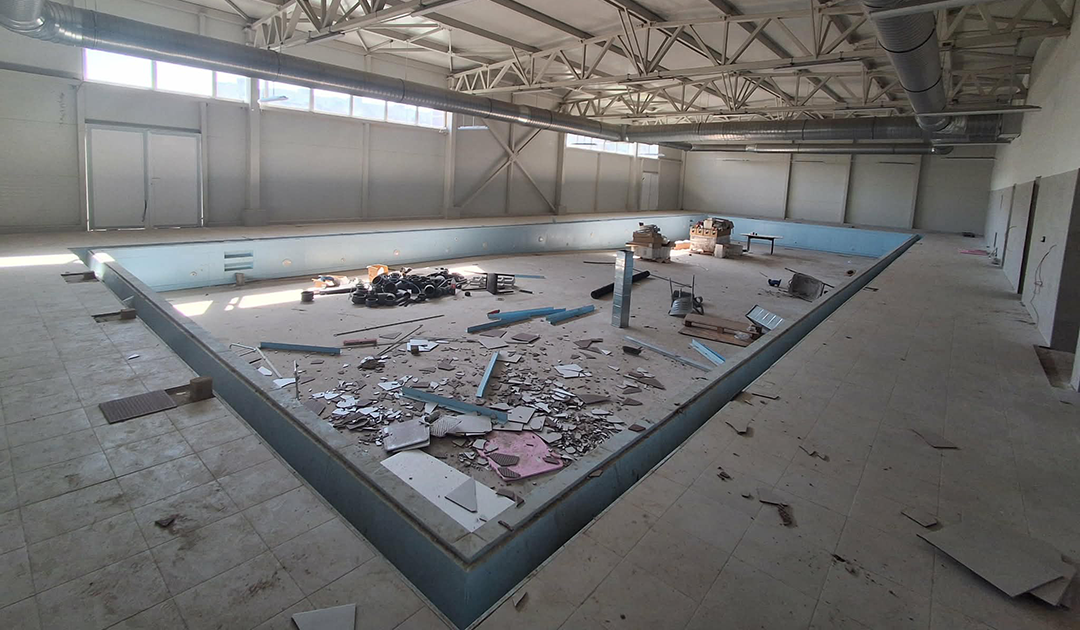
3. Tender of Municipality of Chair: The school swimming pool in Chair, worth 890 thousand euros, for 6 months was completed only on paper.
- Although the Municipality of Chair submitted a notification to the Electronic Public Procurement System on November 21, 2025 that the contract for the construction of an indoor swimming pool in the “Ismail Qemali” Primary School was 100% completed, the facility was only officially launched six months later.
- The Municipality declared the swimming pool completed on the same day it received a report from the supervision which listed unfinished work and still required the connection of the electrical and water supply network in order to perform the final testing of the swimming pool.
- The construction of the swimming pool was initially supposed to be completed in January 2025. Instead of activating the contractual penalty provided for in the contract, the Municipality of Chair extended the deadline for completion twice at the request of the contractor.
- The rush to present the contract as completed comes at a time when the company holding the contract, Eurovia from Zhelino, meanwhile renamed EAKOM from Tetovo, together with another company, applied for a new announcement for the construction of another indoor swimming pool in the Municipality of Chair, this time in the “7 Marsi” school (7 March).
You can read the research in Macedonian, Albanian and English language
For more information, please contact the Center for Civil Communications at (02) 3213-513 or at center@ccc.org.mk.
The research was conducted within the framework of the project “Public Oversight of Public Procurement”, with financial assistance from the Embassy of the Kingdom of the Netherlands in Skopje.